
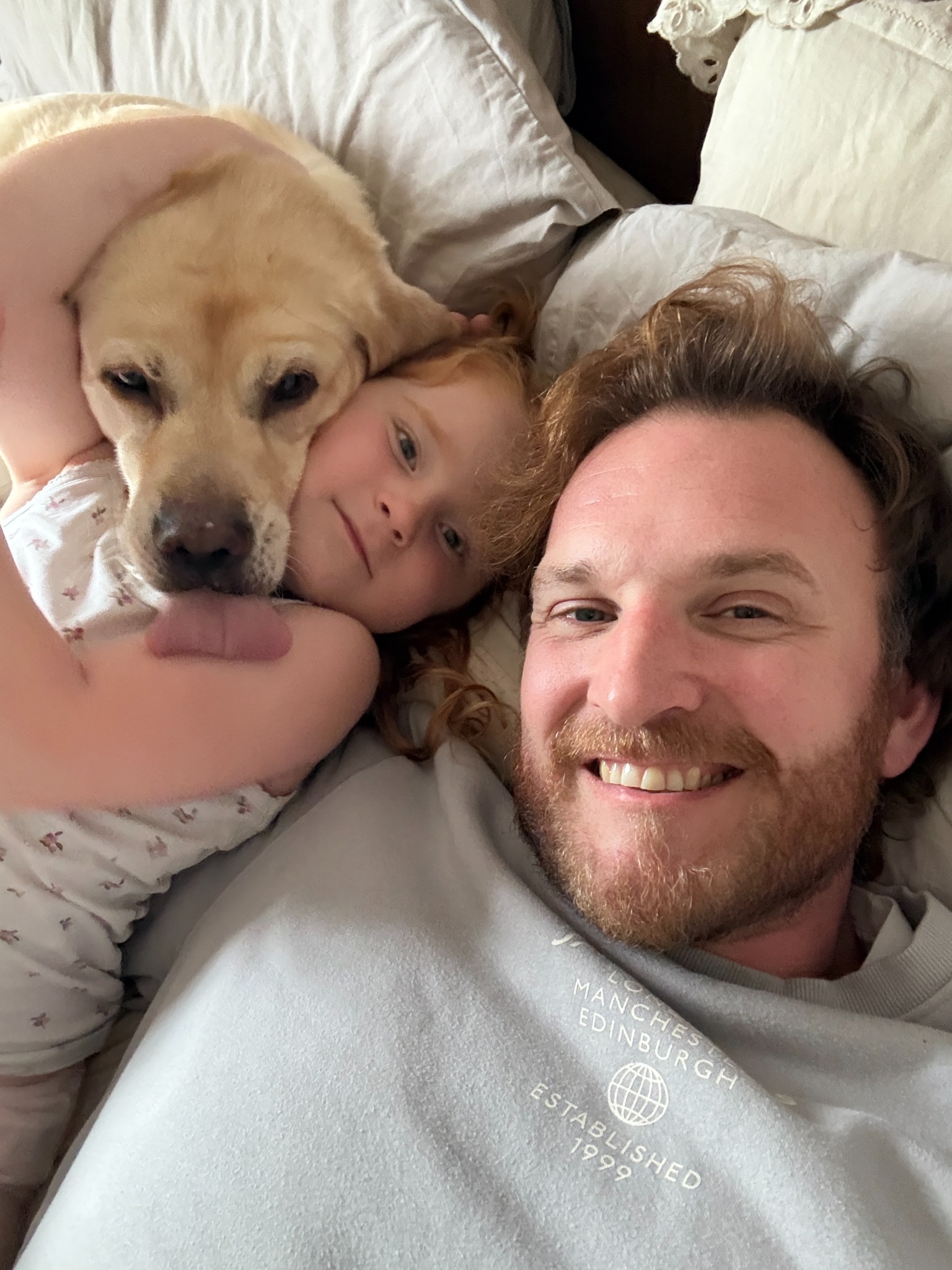
I'm 39 years old. I'm a dad to a wonderful four-year-old daughter, a partner, a dog dad to a seven-year-old golden Labrador, and I run multiple businesses.
And, like a lot of people, I spend a considerable amount of my life feeling as though I'm spinning plates.
Some days, I'm in meetings, making decisions, dealing with finances, answering emails or trying to move one of my businesses forward. Other days, I'm travelling, performing, dealing with something that's broken, or putting out a fire that I didn't even know existed when I woke up that morning.
No two days are ever really the same.
Then, somewhere amongst all of that, there's family life. Being a dad. Being a partner. Walking the dog. The school run. Dinner. Bedtime. All the usual things that come with having a young family.
And I wouldn't change that for the world.
But there is something I've become increasingly aware of as I've got older.
I'm quite good at looking after everyone and everything around me. I'm not always particularly good at looking after myself.
It's not that I don't understand the importance of it. I absolutely do. It's just that, when you've got a hundred things competing for your attention, your own wellbeing can very easily find itself somewhere near the bottom of the list.
And that's something I'm trying to change.
Not because I want to become some sort of picture of perfect health. Not because I suddenly have ambitions to get up at five every morning, meditate for an hour and drink something green that tastes like freshly cut grass.
But because I've come to appreciate something that's actually quite simple.
If my family are my priority, then looking after myself has to be part of looking after them.
And therein lies the key.
When does the working day actually end?
One of the things I've always found difficult about running businesses is that there isn't necessarily a finishing time.
When you're employed in a job with set hours, there's often a fairly obvious point when the working day comes to an end.
You clock off. You leave. You go home.
Of course, that doesn't mean you stop thinking about work, but at least there's a physical separation.
When you're running your own businesses, those boundaries become considerably more blurred.
My phone doesn't suddenly stop receiving messages at five o'clock. Problems don't conveniently resolve themselves because I've decided it's time for dinner. And there is almost always something else that could be done.
Another email to answer. Another idea to explore. Another job that could be finished.
I can be sitting on the couch with my family, physically present, while mentally I'm still working through something that happened six hours earlier.
And I think that's something a lot of people will recognise, whether they're self-employed or not.
Just because you've stopped working doesn't necessarily mean you've switched off.
That's the distinction I've started paying more attention to.
Because there's a difference between finishing work and actually arriving home.
Not arriving at the front door.
Arriving mentally.
Being present.
And sometimes, despite our best intentions, those two things happen at very different times.
The problem with constantly spinning plates
I actually enjoy having a varied working life.
I've never been someone who particularly wanted to sit behind the same desk, doing the same thing, five days a week.
I enjoy the creativity, the challenges, the opportunities and the unpredictability that come with what I do.
But the downside is that my brain rarely seems to get the message that we're finished for the day.
Even when one job is complete, there's usually another three waiting.
And when you've got several businesses, different responsibilities and a young family, there can be a tendency to measure your day by how much you've managed to get through.
How many things have I ticked off?
What still needs done?
What have I forgotten?
What am I going to have to deal with tomorrow?
It's exhausting just writing that.
And the irony is that sometimes, even when I've had a genuinely productive day, I can go to bed thinking about what I haven't managed to accomplish.
I suspect I'm far from alone in that.
But I'm beginning to realise that there's a danger in constantly treating life as one enormous to-do list.
Because the list never really ends.
There will always be another task, another responsibility, another problem to solve.
And if I'm waiting until everything is finished before I give myself permission to relax, I'm going to be waiting a very long time.
Learning how to land
I've been thinking a lot about the transition between work and home life.
I like to think of it as the landing.
That little bit of space between the demands of the working day and the rest of your life.
For some people, it might be the drive home. For others, it's getting changed out of their work clothes, going for a walk, making a cup of tea or simply sitting quietly for a few minutes.
For me, it's not always straightforward.
Sometimes I'm home during the day. Sometimes I'm out working until late at night. Sometimes my working day involves several completely different jobs, and sometimes work and family life overlap from morning until evening.
So the idea of having a perfectly structured evening routine isn't particularly realistic.
And that's fine.
What I'm trying to get better at is recognising that I need some sort of transition.
Something that tells my brain it's okay to stop.
Even temporarily.
It doesn't have to be complicated. In fact, I think the simpler it is, the more likely I am to actually do it.
It might be taking the dog out without spending the entire walk on my phone.
It might be putting the laptop away rather than leaving it open on the kitchen table.
It might be taking ten minutes to sit quietly before moving on to the next part of the day.
Or it might simply be making a conscious decision that whatever I'm worrying about can wait until tomorrow.
That last one is probably the hardest.
Because when you're responsible for businesses, employees, customers and financial commitments, switching off can sometimes feel irresponsible.
As though taking your foot off the accelerator means everything will somehow grind to a halt.
But the reality is that constantly running at full speed doesn't necessarily make you more effective.
Sometimes it just makes you tired.
And being tired isn't exactly conducive to making good decisions, being patient or enjoying time with the people you love.
Being there isn't quite the same as being present
This is probably the part that matters most to me.
My daughter is four.
She's at that wonderful age where everything is an adventure, every question leads to another question, and the smallest things can be the most exciting things in the world.
And those years are flying past.
I know that's a cliché, but it's true.
It feels like no time at all since she was born, and now she's this little person with her own personality, opinions, sense of humour and a seemingly endless supply of energy.
I want to enjoy that.
I want to be involved. I want to make memories. I want to be the dad who has time to play, listen, laugh and be silly.
And I don't want to look back in ten or fifteen years and realise that, although I was physically there, I spent far too much of that time distracted by a phone or worrying about something at work.
Now, I'm not suggesting for a second that I always get this right.
I don't.
There are times when I'm distracted. Times when I'm tired. Times when I've got too much on my mind.
And there are undoubtedly times when my partner would quite reasonably tell me that I'm not listening properly because I'm thinking about something else.
That's life.
But recognising it is important.
Because there's a very big difference between spending time with your family and actually giving them your attention.
And if I'm being truthful with myself, I know I can do better at that.
Not perfectly.
Just better.
The five-minute landing
One thing I'm trying to move away from is the idea that looking after yourself has to involve some grand lifestyle overhaul.
I think that's where a lot of us fall down.
We decide we're going to get fitter, eat better, sleep more, spend less time on our phones and somehow transform ourselves into entirely different people by next Monday.
Then life happens.
A business problem comes up. Someone needs something. The day runs away with us.
And before we know it, the grand plan has been abandoned.
So I'm trying to think smaller.
What can I realistically do with five minutes?
Can I put my phone down?
Can I step outside and get some fresh air?
Can I take a few slow breaths instead of immediately moving from one problem to the next?
Can I stop trying to solve tomorrow's problems tonight?
And perhaps most importantly, can I do those things without feeling guilty about the time I'm supposedly wasting?
Because that's another trap I think busy people fall into.
We've become so accustomed to being productive that doing absolutely nothing can feel strangely uncomfortable.
As though every spare moment needs to be filled with something useful.
But rest is useful.
We're just not particularly good at recognising it as such.
Sometimes ten minutes isn't enough
Of course, there are times when a few minutes of quiet simply aren't going to cut it.
Sometimes you've had a difficult week. Sometimes you're mentally exhausted. Sometimes life has just been relentless.
And that's when I think we need to be a little more deliberate about making time for ourselves.
For some people, that might be the gym. For others, it's going for a long walk, swimming, reading, listening to music or getting out into nature.
For me, working in the wellbeing industry has given me an interesting perspective on this.
Through FLOAT ONE, I've seen how important it can be for people to have somewhere they can genuinely disconnect from the outside world.
And yet, despite owning a float therapy centre, I'm probably as guilty as anyone of not taking full advantage of the opportunity myself.
Which is ridiculous when you think about it.
I spend a considerable amount of my professional life promoting the importance of relaxation, recovery and taking time for yourself.
Then I go home and do precisely the opposite.
There's a certain irony in that.
But perhaps it also makes me appreciate why people struggle to prioritise their own wellbeing.
It's not necessarily because they don't care.
It's because life is busy.
And when you're juggling responsibilities, finding an hour for yourself can feel like an indulgence.
But is it?
If taking that hour helps you feel more settled, more rested and better equipped to deal with everything waiting for you, perhaps it's not an indulgence at all.
Perhaps it's simply part of looking after yourself.
Whether that's floating, exercising, walking the dog or sitting somewhere peaceful with absolutely nothing demanding your attention.
The activity itself matters less than giving yourself permission to do it.
And not feeling the need to justify it.
What happens when it all goes wrong?
Because inevitably, it will.
There will be days when everything runs late.
Days when the phone never stops.
Days when you arrive home exhausted, the house is chaotic, the dog needs walked, your child needs attention and there's still a mountain of things to do.
On those days, the idea of finding twenty minutes of peace and quiet might seem laughable.
And I think it's important to acknowledge that.
There is no point creating another set of expectations that simply adds to the pressure we're already under.
The last thing any of us needs is to start feeling guilty because we've somehow failed at relaxing.
So maybe, on those days, the landing is nothing more than a moment.
A conscious breath.
Putting the phone down.
Giving your partner a proper hug.
Sitting on the floor and playing with your child for ten minutes.
Taking the dog out and noticing the world around you rather than mentally rehearsing tomorrow's workload.
Small things.
Ordinary things.
Things that don't require money, equipment, a booking or a carefully planned schedule.
And if you don't manage any of them?
Well, tomorrow is another day.
That's something I'm learning too.
Not every day needs to be a success story.
Looking after myself is looking after my family
I think this is where my thinking has changed most.
For a long time, I've associated being a good provider with working hard.
Putting the hours in.
Making sacrifices.
Doing whatever needs to be done to create security and opportunities for my family.
And I still believe there's enormous value in that.
I want my daughter to grow up understanding the importance of hard work, commitment and taking responsibility.
But I also want her to understand that life isn't supposed to be an endless cycle of work, stress and exhaustion.
I want her to see that it's okay to rest.
That taking care of your physical and mental wellbeing matters.
That being successful means very little if you're too exhausted to enjoy the life you're working so hard to build.
And I suppose that means I need to lead by example.
Because children don't just listen to what we tell them.
They watch what we do.
If I'm constantly stressed, distracted, rushing from one thing to another and never making time for myself, what am I teaching her?
That's not the example I want to set.
I want to be healthy enough to run around with her.
Patient enough to listen to her stories.
Present enough to enjoy the little moments.
And hopefully, years from now, fit and well enough to continue being a big part of her life as she grows older.
I want to be a good partner, too. Someone who has enough left in the tank at the end of the day to contribute properly to our relationship and our family life.
And none of that is particularly achievable if I'm constantly running myself into the ground.
Looking after myself isn't taking something away from my family. It's an investment in the person they depend on.
That's the bit I think I needed to understand.
Seven days, one small change
I'm not going to finish this article by suggesting everyone needs to follow a seven-step programme or completely rethink their daily routine.
That would rather defeat the purpose.
But I do think there's value in paying attention to how we move from one part of our lives to another.
So here's something I'm going to try.
For the next week, I'm going to make a conscious effort to recognise when my working day, or at least a particular part of it, has finished.
Before diving straight into the next responsibility, I'm going to try to create a little space.
Some days that might mean five minutes.
Other days I might manage half an hour.
And occasionally, I might actually take some proper time out for myself.
I'm not going to measure it, track it or turn it into another task that needs ticking off.
I'm simply going to try to become more aware of it.
To notice when I'm carrying work into family time.
To recognise when I'm tired and need a break.
And to remind myself that the world isn't going to fall apart because I haven't answered an email immediately.
At least, I hope it isn't!
A little less world, a little more life
I'm 39.
I've got businesses I want to grow, ambitions I want to achieve and plenty of plans for the future.
I'm not about to stop working hard.
It's part of who I am, and I genuinely enjoy what I do.
But I also have a wonderful family, a little girl who's growing up far too quickly, a partner who deserves the best version of me, and a Labrador who couldn't care less about my workload as long as he gets his walk.
And when I really think about it, those are the things that matter most.
Not the unanswered emails.
Not the never-ending list of jobs.
Not whether I've managed to squeeze another productive hour out of an already exhausting day.
It's the people I love.
The time we spend together.
The memories we're making.
And the life we're trying to build.
I know I don't look after myself as well as I should.
I'm working on it.
I also know that I'm not suddenly going to become brilliant at switching off overnight.
There will still be long days, late nights, financial pressures, business challenges and moments when I feel like I'm juggling far too much.
But perhaps the answer isn't to become better at juggling.
Perhaps it's learning that, every now and again, it's okay to put a few plates down.
To stop.
To breathe.
To land.
Because ultimately, I don't want to spend my life so busy trying to provide a good life for my family that I forget to actually live it with them.
And if I really want to give them the best of me, I have to start making sure there's enough of me left to give.
That's not selfish.
That's responsibility.
And for me, that's what The Landing is really about.
A little less world. A little more of what matters.
Alex Robertson